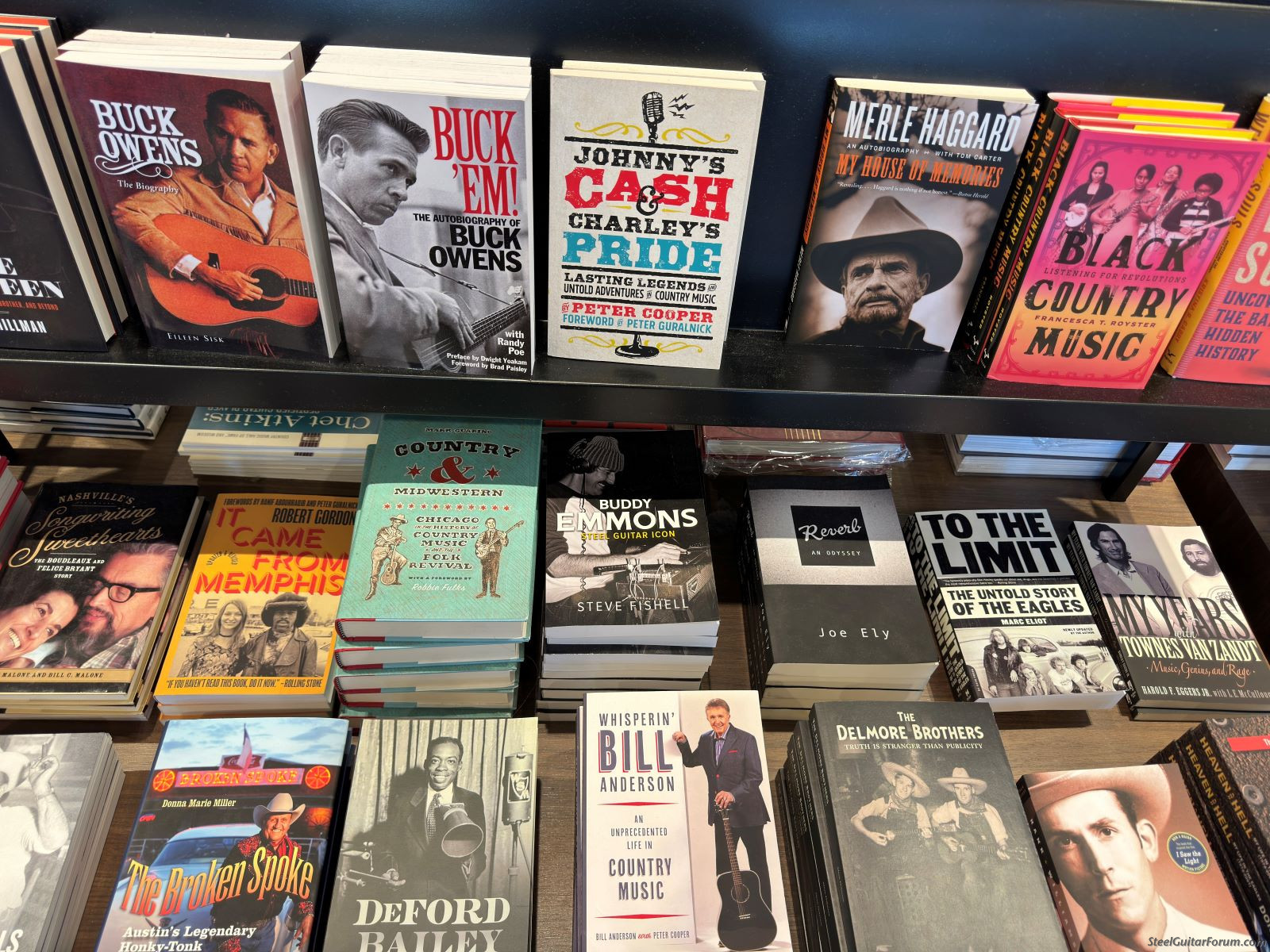
I don't know if it has been mentioned before here on SGF, but Steve Fishell's book entitled "Buddy Emmons - steel guitar icon" is a great read for anyone into steel guitar. There are very interesting stories about Buddy's career, techniques, inventions and remarkable practice habits, such as playing in the dark. It's a MUST for you all....
Buddy Emmons book
Moderators: Dave Mudgett, Brad Bechtel
-
Eric Hershkowitz
- Posts: 28
- Joined: 29 Mar 2019 9:45 am
- Location: California, USA
-
Dean Parks
- Posts: 587
- Joined: 9 Jul 2004 12:01 am
- Location: Sherman Oaks, California, USA
-
Diane Diekman
- Posts: 155
- Joined: 9 Aug 2011 7:35 am
- Location: South Dakota, USA
Here's my review from 2022: https://internetreviewofbooks.blogspot. ... -icon.html
Diane Diekman
Sioux Falls SD
Author of "Randy Travis: Storms of Life"
Author of "Twentieth Century Drifter: The Life of Marty Robbins"
Author of "Live Fast, Love Hard: The Faron Young Story"
Sioux Falls SD
Author of "Randy Travis: Storms of Life"
Author of "Twentieth Century Drifter: The Life of Marty Robbins"
Author of "Live Fast, Love Hard: The Faron Young Story"
-
joe long
- Posts: 874
- Joined: 30 Jun 1999 12:01 am
- Location: San Antonio, Texas
-
Roger Crawford
- Posts: 5462
- Joined: 10 Sep 1999 12:01 am
- Location: Griffin, GA USA
-
Craig Stock

- Posts: 3936
- Joined: 24 Nov 1999 1:01 am
- Location: Westfield, NJ USA
-
robert kramer
- Posts: 2110
- Joined: 27 Nov 1999 1:01 am
- Location: Nashville TN
-
W. C. Edgar

- Posts: 757
- Joined: 28 Feb 2005 1:01 am
- Location: Iowa City Iowa, Madison CT, Nashville, Austin, Phoenix, KC, DFW, New York Soon!
Great Read
Great read, I enjoyed very much
Thanks Russ Wever!
Thanks Russ Wever!
World Class Songwriter
First owner of Steelseat.com
1980 Sho-Bud Pro II & 1977 Sho-Bud Pro l
Lawrence 610 Pickups
1979 Peavey LTD
1980 Peavey Nashville 400
Goodrich L-120
Toured with Tim McGraw, Alan Jackson, Ty England, Marty Haggard, Whitey Morgan, BB Watson, Opryland USA's Country Music USA Show, Jeff Carson, Dale Watson, Leroy Van Dyke, Lucky Tubb & more
First owner of Steelseat.com
1980 Sho-Bud Pro II & 1977 Sho-Bud Pro l
Lawrence 610 Pickups
1979 Peavey LTD
1980 Peavey Nashville 400
Goodrich L-120
Toured with Tim McGraw, Alan Jackson, Ty England, Marty Haggard, Whitey Morgan, BB Watson, Opryland USA's Country Music USA Show, Jeff Carson, Dale Watson, Leroy Van Dyke, Lucky Tubb & more
-
Jack Tekiela
- Posts: 37
- Joined: 12 Jul 2023 1:04 pm
- Location: Chicago, Il.
-
J D Sauser

- Moderator
- Posts: 3292
- Joined: 4 Aug 1998 11:00 pm
- Location: Wellington, Florida
I think I reviewed the book soon after I got it. I read thru it like I had last read a book maybe 20 years ago... I couldn't stop.
I would tend to assume that most are interested by his story after he became proficient, known and professional and the stories about whom with and where, and I feared that would be what the book would be mostly about.
I was mostly interested about his earliest days and HOW he learned and while I had a theory about him having had an early interest in Jazz, Be-&-Hardbop, the first 3rd of the book proved very resourceful and revealing: His early fascination for Jazz Blues (which remained one of his favorite show-offs) and Bebop, the fact that the first record he bought was had Coltrane, Cannoball Adderly and other Bebop Greats on it (MGC 601 https://youtu.be/fdQoeBKYVL4 and it's back side MGC 602 https://youtu.be/zfpPC_1Te4A) the back side he wore out, as the story goes on.
His "hiding" in the basement and playing "blind" in the dark. While he didn't play staring into emptiness like Bobby Koeffer was known for, BE was able all thru his career to look up and smile at the audience, a singer or buddy session musician while soloing, for extended periods and remain creative, in control and in perfect intonation.
The book confirmed some of my suspicions on his musical inclinations and also changed the way I go about practicing.
I wished BE had been aware of the importance of HOW he learned and have felt compelled to share it while he was active on this Forum. I do not think that he held back, but that over the years, especially after that event described in the book in the late 60's or early 70's when he threw up his bar exclaiming "I can't f'up anymore", I think his method had bore the fruit he had been after and he never looked back again. Why would he.
I remember in the late-late 90's when Maurice surprised everybody suddenly showing up with a non-pedal steel instead of his "feared" Bb6th-Universal with 8&5 on one single 12 string neck and play the living daylights out of it, I called him up and asked for a few full day lessons in single note improvisation on C6th. To me, it was 2 things at once, single note playing AND improvising (which I was a novice at both). Maurice told me "let me think about how to go about that, I call you back in a couple of days"... I told him there and then, just show me how YOU learned it. Teacher often forget that. 3 days later Maurice called and said, "I had to go way back but I think I know how to show you".
I and I know some others asked BE "what are you thinking when you play" or if he would tutor them one-on-one.
The answer I got to the first question and I read that he told many others to the same question, ranged from "I don't really know what I am thinking" to "I am not sure I AM thinking". You can imagine the answer to the second question. He was a very honest person. Ha!
Again, I wished he had ben conscious of how important his memories about his early days were. I am glad the writer was able to extract and save this information before it would vanish with him so too soon.
Thanks!... J-D.
I would tend to assume that most are interested by his story after he became proficient, known and professional and the stories about whom with and where, and I feared that would be what the book would be mostly about.
I was mostly interested about his earliest days and HOW he learned and while I had a theory about him having had an early interest in Jazz, Be-&-Hardbop, the first 3rd of the book proved very resourceful and revealing: His early fascination for Jazz Blues (which remained one of his favorite show-offs) and Bebop, the fact that the first record he bought was had Coltrane, Cannoball Adderly and other Bebop Greats on it (MGC 601 https://youtu.be/fdQoeBKYVL4 and it's back side MGC 602 https://youtu.be/zfpPC_1Te4A) the back side he wore out, as the story goes on.
His "hiding" in the basement and playing "blind" in the dark. While he didn't play staring into emptiness like Bobby Koeffer was known for, BE was able all thru his career to look up and smile at the audience, a singer or buddy session musician while soloing, for extended periods and remain creative, in control and in perfect intonation.
The book confirmed some of my suspicions on his musical inclinations and also changed the way I go about practicing.
I wished BE had been aware of the importance of HOW he learned and have felt compelled to share it while he was active on this Forum. I do not think that he held back, but that over the years, especially after that event described in the book in the late 60's or early 70's when he threw up his bar exclaiming "I can't f'up anymore", I think his method had bore the fruit he had been after and he never looked back again. Why would he.
I remember in the late-late 90's when Maurice surprised everybody suddenly showing up with a non-pedal steel instead of his "feared" Bb6th-Universal with 8&5 on one single 12 string neck and play the living daylights out of it, I called him up and asked for a few full day lessons in single note improvisation on C6th. To me, it was 2 things at once, single note playing AND improvising (which I was a novice at both). Maurice told me "let me think about how to go about that, I call you back in a couple of days"... I told him there and then, just show me how YOU learned it. Teacher often forget that. 3 days later Maurice called and said, "I had to go way back but I think I know how to show you".
I and I know some others asked BE "what are you thinking when you play" or if he would tutor them one-on-one.
The answer I got to the first question and I read that he told many others to the same question, ranged from "I don't really know what I am thinking" to "I am not sure I AM thinking". You can imagine the answer to the second question. He was a very honest person. Ha!
Again, I wished he had ben conscious of how important his memories about his early days were. I am glad the writer was able to extract and save this information before it would vanish with him so too soon.
Thanks!... J-D.
__________________________________________________________
Was it JFK who said: Ask Not What TAB Can Do For You - Rather Ask Yourself "What Would B.B. King Do?"
A Little Mental Health Warning:
Tablature KILLS SKILLS.
The uses of Tablature is addictive and has been linked to reduced musical fertility.
Those who produce Tablature did never use it.
I say it humorously, but I mean it.
Was it JFK who said: Ask Not What TAB Can Do For You - Rather Ask Yourself "What Would B.B. King Do?"
A Little Mental Health Warning:
Tablature KILLS SKILLS.
The uses of Tablature is addictive and has been linked to reduced musical fertility.
Those who produce Tablature did never use it.
I say it humorously, but I mean it.
-
Roger Rettig

- Posts: 11162
- Joined: 4 Aug 2000 12:01 am
- Location: Naples, FL
Buddy was generally very accessible and forthcoming; how I miss the days when he would pop up here on the Forum and contribute to a thread, always with logic and good sense and usually with a humorous twist!
Steve Fishell's book is remarkable. Despite the fact that Emmons called a halt to the interviews and note-taking at a certain point, the story is seamless and there's no indication that his source was no longer available.
We're all surely grateful that Buddy gave Steve permission to use what he had when the time came.
Emmons is arguably THE most influential player in history. Steve - no slouch himself (!) - has crafted an important account of a unique musical journey by one of America's finest musicians.
Steve Fishell's book is remarkable. Despite the fact that Emmons called a halt to the interviews and note-taking at a certain point, the story is seamless and there's no indication that his source was no longer available.
We're all surely grateful that Buddy gave Steve permission to use what he had when the time came.
Emmons is arguably THE most influential player in history. Steve - no slouch himself (!) - has crafted an important account of a unique musical journey by one of America's finest musicians.
Roger Rettig: Emmons D10, B-bender Teles, Martins, and a Gibson Super 400!
----------------------------------
----------------------------------